
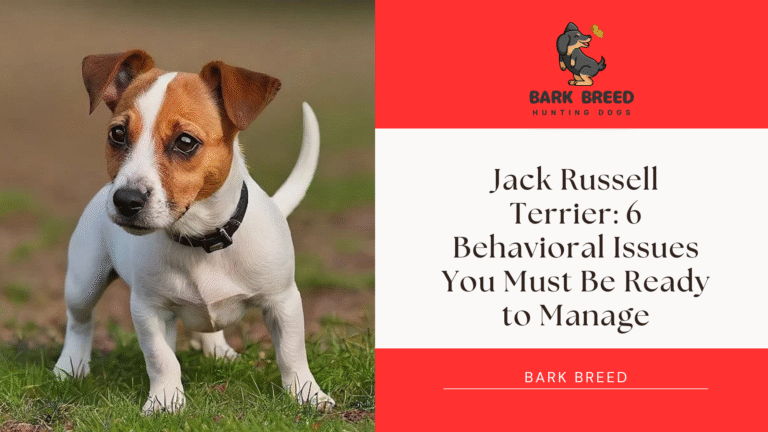
- Introduction: Small Dog, Big Personality—What to Know About Jack Russell Terriers
- 1. High Energy, Low Patience: The Need for Constant Stimulation
- 2. Bark First, Think Later: Vocal Tendencies and Triggers
- 3. Chasing Everything That Moves: Prey Drive Problems
- 4. Stubbornness in Disguise: Smart, but Not Always Cooperative
- 5. Territorial and Possessive: Guarding Behavior in the Home
- 6. Separation Anxiety in a Bold Package
- Conclusion: A Jack Russell Terrier Isn’t Difficult—Just Different
- FAQs About Jack Russell Terrier Behavior
Introduction: Small Dog, Big Personality—What to Know About Jack Russell Terriers
This is a small ball of energy, brains, and attitude known as the Jack Russell Terrier. Do not be deceived by its size. Bred to hunt the fox, these are dogs that are fearless and concentrated and never give up when they have a task at hand. However, their adventurous spirit makes them great to hang around with, but also makes them difficult to live with, particularly for first-time dog parents.

Whether it involves endless zoomies or headstrong tendencies and severe prey drive, the Jack Russell — along with his propensity to be the spirited pet he is in the first place- comes with a special set of behavioral tools that need active management. Unless properly structured and stimulated, this highly compact breed will, within a short time, prove to be more than a handful!
In this post, we are going to break down 6 typical behavioral challenges that Jack Russell Terrier owners should expect- and what you can do to address each challenge, with confidence. Be it that you already have one or are thinking of getting one to join your family, you should know what to expect, as this is the first step towards creating a valuable relationship with the stalwart breed.
1. High Energy, Low Patience: The Need for Constant Stimulation
Jack Russell Terrier is a breed that is hard-wired to run at full speed. These dogs have their origins in the fox hunting dogs and have endless energy and acute focus. The energy that the dog possesses accumulates rapidly when the dog is not provided with adequate stimulation daily and will overflow into other forms of destructive behavior, such as digging, chewing, and excessive barking.
An unengaged Jack Russell is not only bouncing off the walls, but he/she is a full-fledged cyclone. One needs to provide them with a combination of both mental and physical outlets to keep them balanced. Dog agility courses, odor games, puzzle toys, leashed walks, and off-leash play, but in dedicated areas. These are not things that fall in the category of extras, but they are things to keep your home and your sanity intact.
2. Bark First, Think Later: Vocal Tendencies and Triggers
The Jack Russell Terrier barks instinctively anon d most occasions, they do very well to find an excuse to bark. They are good watchdogs with a keen sense of hearing that rushes to point out every movement of a squirrel, a footstep, or a shadow. Though not all barking is a sign of protection, it is not hard to turn into compulsive barking in case it is not handled early. It is important to learn to tell the difference between valuable signals and fearful signals.
Instead of reprimanding or scolding the dog as he/she barks, the aim should be to redirect his or her excess energy and reward the dog when he or she is calm. Over time, the nuisance barking can be drastically reduced through instructing a solid and consistent quiet command and not allowing them too much mental stimulation.
3. Chasing Everything That Moves: Prey Drive Problems

A Jack Russell Terrier, when it can run, will want to chase it, and that is that. The high prey drive nature of this breed is deeply rooted in nature, and cats, squirrels, and birds are fair game as well as joggers. This conduct, when left uncontrolled, is perilous and hard to handle. Never leave your Jack Russell unleashed unless you are somewhere in a very secure and confined place. Put some effort into good recall and leash manners, and offer safe outlets to them working on the need to chase something, as through flirt poles, fetching toys, or agility. You can never get rid of the prey drive–but you can channelize it fruitfully.
4. Stubbornness in Disguise: Smart, but Not Always Cooperative
The Jack Russell Terrier is not only unquestionably smart, but he or she is smart with an independent streak that borders on fierce. It often happens that the owners take their independence as stubbornness, when actually the reason is just being able to think on their own.
One must be both consistent and creative when training a Jack Russell and also be patient. The most frequent errors are caused by harsh corrections or missing out on organized routines. Clicker training, treats, and praise are some types of positive reinforcement that are more likely to work. Such dogs are easily excited by interaction and realistic expectation, or you may have to outsmart them. Your Jack Russell will be more eager to play along the more mental stimulation the training course provides.
Check Out: Finnish Spitz: 6 Common Training Mistakes That Can Lead to Excessive Barking.
5. Territorial and Possessive: Guarding Behavior in the Home
Jack Russell Terriers can be territorial in spite of their tiny size. The owner of many dogs finds that the animal may develop a possessive craving to food bowls, favorite toys, sleeping places, or even certain individuals. Such guarding behavior can manifest itself through growling, snapping, or rigid body movements when a person is going towards what they claim as theirs or by going towards their area.
This, in essence, is resource guarding, usually a defense mechanism related to insecurity, loss of an attachment to something prized, and/or a failure to have clear boundaries. Punishment is not the solution, but a combination of desensitization, counter-conditioning, and consistent leadership. It will go a long way toward trust and alleviating the tensions around guarded resources to teach your Jack Russell that sharing is rewarding and to strengthen polite behavior.
6. Separation Anxiety in a Bold Package

It may seem that the Jack Russell Terrier is fearless and independent in most cases, but he is not able to combat being alone easily. This breed is prone to separation anxiety, and in most cases, separation anxiety can be seen when the dogs are excessively attached to their humans. There may be some indications, such as incessant barking, the tendency to destroy objects and chew them up, pacing, or even bathroom malfunctions when you are away, even briefly. The behaviors are not revengeful acts; it is a sign of panic and distress.
To cope with your Jack Russell, it is wise to build the dog towards independence: building it up, crates, crate training, and neutral departures can all be used to build independence. You could also combine a few puzzle feeders, a calming routine, and some background noises, such as music, to help them feel calmer in your absence. It is all about being patient and consistent.
Conclusion: A Jack Russell Terrier Isn’t Difficult—Just Different
Jack Russell Terrier ownership is an ambitious action- and as such, the rewards can be as great as the issues. They are really smart, athletic, life-of-the-party dogs, although, not a set it and forget it kind of breed. Their behavioral quirks, such as excessive energy, vocal disposition, and excessive prey drive, among other issues, cannot be handled by love alone; dedication, consistency, and psychological attention are required.
With that said, given a suitable tact, a Jack Russell will be an entertaining, loyal, and highly bonded pet. Knowing what they want to do, fulfilling their needs, and employing positive, controlled training will bring the best of them out-and the best of you as an owner. Provided that you are willing to stay in pace, it is a journey worth making.
For more info: Click Here.
FAQs About Jack Russell Terrier Behavior
1. Are Jack Russell Terriers good as a first dog?
Not usually. Although they are cute and small, the Jack Russell Terriers are high-maintenance dogs in terms of their energy needs, training requirements, and behavioural management. The novel owners tend to underestimate the impact of stimulation and structure required by this breed.
2. Is it possible to teach a Jack Russell Terrier to quit barking?;’
Not all barking can be eliminated, a barking is in their nature as watchdogs, but you can train your Jack Russell Terrier to bark less. When combined with regular training, teaching a quiet command, managing triggers, and redirection can go a long way.
3. Do other dogs enjoy the company of Jack Russell Terriers?
It depends. Jack Russell Terriers are highly prey-driven; hence, they may be harmful in the presence of smaller pets like cats or rodents. The socialization process in the beginning is on the correct path, though there should be monitoring and training needed to keep the society in peace with a multi-pet household.