
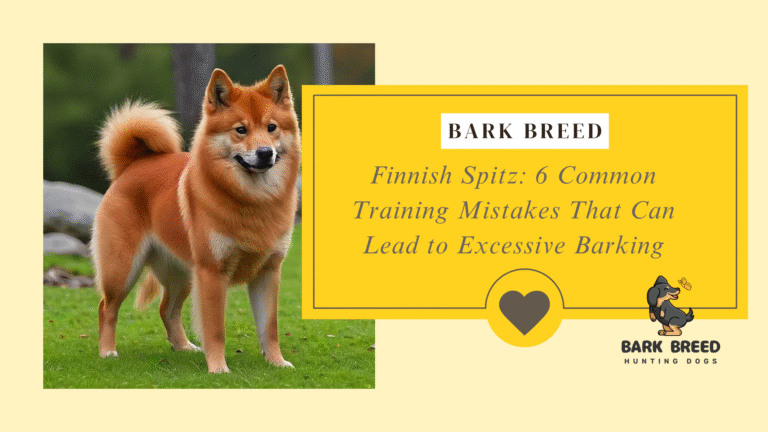
- Introduction: Born to Bark—But That Doesn’t Mean Out of Control
- 1. Ignoring Their Vocal Nature Instead of Redirecting It
- 2. Inconsistent Training: Mixed Messages Equal More Barking
- 3. Not Providing Enough Mental Stimulation
- 4. Failing to Socialize Early and Often
- 5. Using Harsh or Punitive Training Techniques
- 6. Reinforcing Barking Without Realizing It
- Conclusion: Don’t Silence the Spitz—Train Them Smartly
- FAQs
- 1. Would this mean that we can train a Finnish Spitz to bark less?
- 2. When do you begin to train a Finnish Spitz?
- 3. Do Finnish Spitz dogs make apartment living?
- 4. Are there any dogs classified as the Finnish Spitz breed that are barking more than the others?
- 5. Eliminating the future chances of a Finnish Spitz barking is there?
- 6. Which activities can I undertake to mitigate barking in a Finnish Spitz?
Introduction: Born to Bark—But That Doesn’t Mean Out of Control
The Finnish Spitz is known as “The Barking Bird Dog”-with good reason. Naturally developed to make high-pitched, game-alerting vocalizations used to hunt game, this breed has barking in its genes. They are expressive, have good senses, a nd an outgoing personality, thus making them good watchdogs and a nightmare to owners who do not know what to expect.

When your Finnish Spitz appears to be barking at anything at all, the doorbell, a falling leaf, you are not the only one. Although some amount of barking is both normal and expected (and even necessary to some degree), a continuous excessive amount of barking is more often than not the indicator of a training problem- not merely the issue of a poorly behaved dog.
In this post, we are going to go through 6 typical training mistakes that even seasoned owners can make, and that actually tend to prompt more barking instead of putting it under control. Avoiding these pitfalls is the solution to a quieter, more peaceful household in case you want a happy, vocal, yet manageable Finnish Spitz.
1. Ignoring Their Vocal Nature Instead of Redirecting It
The Finnish Spitz was created to be barkers-it is in their job description. This breed was actually bred to hunt game birds, and because of that, it can be quite vocal, alerting the hunters with a loud (and persistent) bark, so it is not being naughty when it barks, it is being of instinct. The major mistake first-time owners make is that they attempt to keep the situation more or less under control by chastising or punishing.
This is usually counterproductive, and ensuing frustration or anxiety may also result. Rather, put their vocal impulses to effective use. Issue verbal commands such as speak, quiet, so your dog understands when he is allowed to bark- and when he is expected to shut up. Displace, but do not repress.
2. Inconsistent Training: Mixed Messages Equal More Barking
Do not expect good results when your Finnish Spitz gets mixed messages. One thing that often happens is not being very consistent about whether it is okay to bark–laughing when they bark at squirrels, then yelling at them the next time they bark at the mailman. Dogs live on consistency and clarity. The discrepancy in their responses already causes confusion that, in turn, promotes more barking. Give straightforward rules, remain steadfast and use uniform commands, and make everyone in the home unified. A familiar setting makes your Finnish Spitz feel safe- and more unwilling to overreact with barking.
Check Out: Jack Russell Terrier: 6 Behavioral Issues You Must Be Ready to Manage.
3. Not Providing Enough Mental Stimulation
Finnish Spitz dogs are natural thinkers, watchdogs, and are addicted to mental stimulation. It will not do any good simply to remove them on a daily walk. Such dogs without adequate stimulation will engage the self-entertainment, which, on most occasions, is the barking, digging, and chasing shadows. The solution? Work out their brains. Keep them pets entertained, filling them with challenge toys and odiferous games, and obedience training. A tired Finnish Spitz will not go barking so easily since the dog would do anything to fill the silence.
4. Failing to Socialize Early and Often

The under-socialized Finnish Spitz will consider every new person, sound, or animal as a danger and bark. These dogs require frequent positive socialization with the outside world since they are puppies. Making them too sheltered is one of the largest training mistakes to be precise in the initial stage of development, and especially the developmental window (816 weeks).
Exposing your dog to a diverse environment in terms of sights, sounds, and social experiences safely allows the development of confidence and minimizes behavioral problems such as excessive reactive barking. There is no need to tell them all at once–they need to be exposed to it slowly, sensitively.
5. Using Harsh or Punitive Training Techniques
Brave and highly confident, the Finnish Spitz is a sensitive breed as well. Corrective measures such as shouting, jerking of the leash, or training using punitive measures most of the time do more harm than good. These techniques may instead result in fear, anxiety, or collapse in place of decreased barking. Regrettably, aversive tools come into play when the barking of the dog becomes excessive to some of its owners.
However, the secret to being successful with this breed is the establishment of trust. Using positive reinforcement, which is praising calm behavior and giving calm, consistent direction, leads to improved obedience in the long term and a fuller connection between you and your dog.
6. Reinforcing Barking Without Realizing It

A lot of owners continue encouraging barking, and do not even realize that they are doing this. Giving your dog a treat is just one of the ways to reinforce this behavior by opening the door when they bark or even making eye contact with the dog and telling him No. To a Finnish Spitz, attention is attention- even negative. The trick is to only reward quiet, calm behavior. Learn to ignore barking except when there is a necessity and reward silence instead. Time, time, time: wait until there is a break, praise, and treat. As time goes on, it will understand that the silence, not the noise, is the way to rewards in a Spitz.
Conclusion: Don’t Silence the Spitz—Train Them Smartly
The Finnish Spitz cannot come off the barking altogether, and this would not be desirable. They are what they are. This is aimed at achieving intelligent behavior, which is manageable, other than being silent. Gain understanding of the breed, avoid their most frequent training pitfalls, and have a training partner, and you will succeed in having a well-rounded, vocal companion. It runs to patience, training, and years of positive, reinforcing rewards, to turn a Finnish Spitz into a contented, season-long barker, well-adjusted family pet.
For more info: Click Here.
FAQs
1. Would this mean that we can train a Finnish Spitz to bark less?
Yes! Even though you cannot/should not stop excessive barking, you can reduce excessive barking by early socialization, redirection, and constant, positive reinforcement. It is rather useful to break them into training that on spouting and acting at being silent.
2. When do you begin to train a Finnish Spitz?
Ideally, start training at 8 weeks old. Good behavior is based on early socialization, exposure to various environments, and simple commands it including managing barking.
3. Do Finnish Spitz dogs make apartment living?
Finnish Spitz are happy to live in apartments, but they are vocal and high-energy, so it is best paired with a house that has space, or with neighbors who would not mind the occasional bark (or ten). Exercise and mental stimulation are required.
4. Are there any dogs classified as the Finnish Spitz breed that are barking more than the others?
And, the Breed of Finnish Spitz is a very talkative dog. Barking is natural because it has been known that they were originally bred to bark in a hunt to draw the attention of their handlers. It has nothing to do with bad behavior; it is a matter of communication. It is possible to instruct them when to bark and when not to under correct training.
5. Eliminating the future chances of a Finnish Spitz barking is there?
No, and you must make an effort not to gag them, so to speak. Barking is a good part of the Finnish spitz character and its history. It does not mean that the goal is to eliminate the barking, but rather manage it and intercept the barking through training and mental enrichment. Speak and quiet are some of such commands, which will enable you to take better control of your vocal activities.
6. Which activities can I undertake to mitigate barking in a Finnish Spitz?
The most important issue is mental and physical enrichment. Boredom-related factors of barking can be reduced with activities that include scent games, interactive puzzle toys, obedience training, and long walks in new settings. Mentally stimulating your Finnish Spitz will aid in expenditures of energies that may potentially be spent in over-vocalizing.